Get the latest insights and updates delivered straight to your inbox weekly.
Money20/20 2026
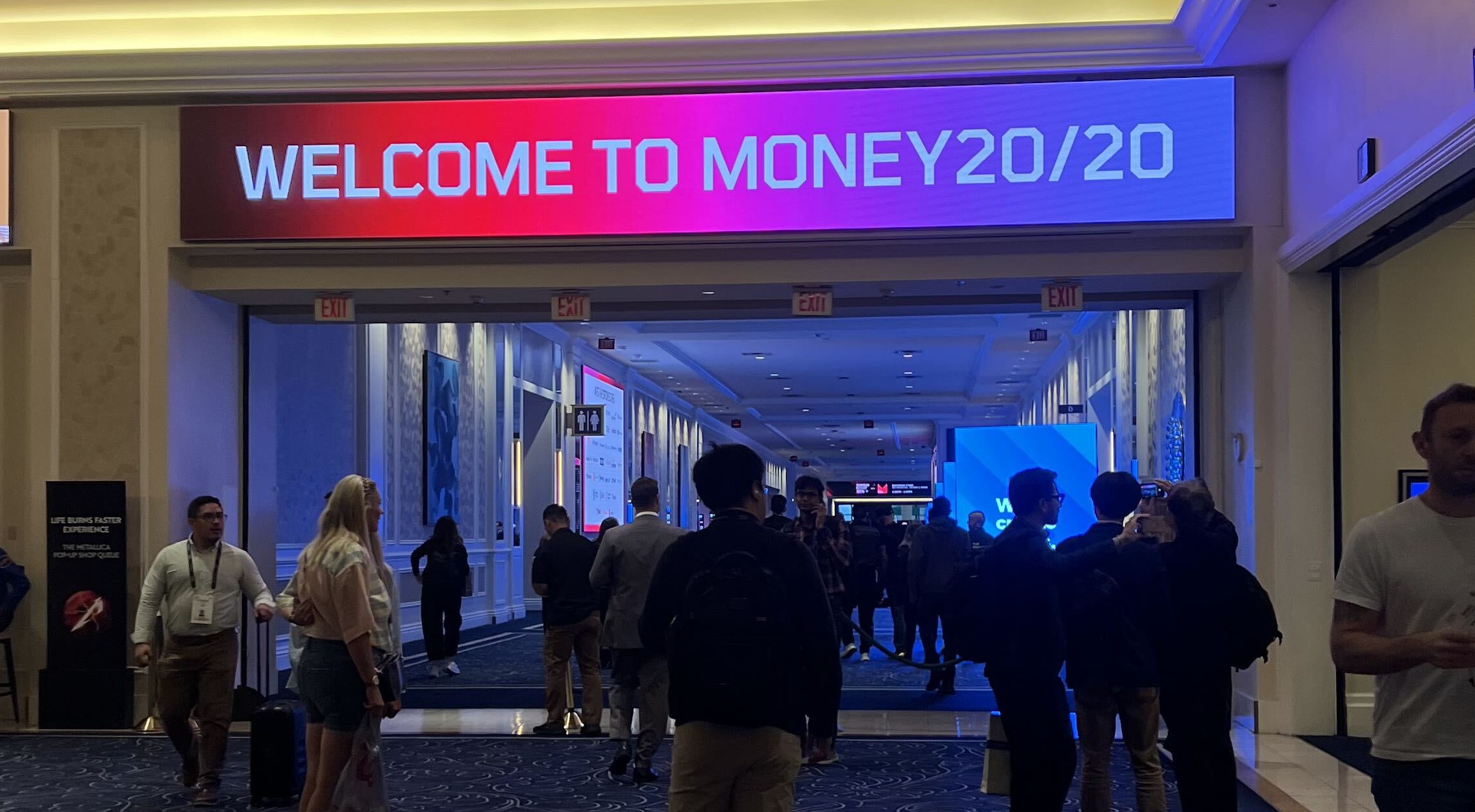
If one question ran through every stage, panel and coffee queue at Money20/20 USA in Las Vegas this year, it was this: when an AI agent shows up to move money, how do you know who sent it, and whether they meant it?
Agentic AI dominated the agenda. Agentic commerce had its own day on the main stage in Las Vegas, with American Express, Google, Coinbase and Citi on panels. Payment networks have moved fast: Visa's Trusted Agent Protocol and Mastercard's Agent Pay both let merchants cryptographically recognise a registered AI agent. Twilio, meanwhile, has been building the communications and identity layer that sits between banks, their customers and the agents now acting for both.
At Zing, we spend every day building on that layer. We are a UK-headquartered Twilio Gold partner that builds exclusively on the Twilio stack, with 100+ customers worldwide, and this year we were at Money20/20 as one of the partners on Twilio's stand. This post walks through the six conversations we kept having at the show, and what we think financial services teams should do about each one.
1. Compliance: from a project blocker to a built-in feature
Compliance should be designed into the conversation, not bolted on after go-live. That is the single biggest shift we saw, and it is what makes fast delivery possible in a regulated business.
Traditionally, compliance slows projects down because it is reviewed at the end. Call recordings are sampled by hand, disclosures are checked after the fact, and every new channel triggers a fresh risk assessment. AI changes the economics of each of those steps:
- Every interaction can be checked, not a sample. AI can review 100% of calls and chats for required disclosures, vulnerable-customer cues and complaint signals, and flag the exceptions for a human. Twilio Conversation Intelligence, part of the new Twilio Conversations layer, does this out of the box: its Script Adherence operator and custom compliance operators run in real time during the conversation or after it ends.
- Controls become configuration. Consent capture, PCI-safe payment collection, data redaction and retention rules can be built into the Twilio flow itself, so every journey inherits them.
- Evidence is produced as you go. Every agent action, human or AI, leaves an auditable trail that answers the regulator's question: who did what, on whose authority, and why.
Speed without shortcuts: We work in three stages, each with a clear goal: crawl, walk, run. Crawl: we take an initial busy journey live with compliance built in, and your risk team checks and approves it. Walk: we reuse the same controls, like building blocks, for the next journeys, so each one goes live much faster. Run: the proven patterns scale across your channels and teams.
2. Do we need fewer humans, or the same humans doing better work?
Our answer: the same humans, doing higher-value work. In financial services, "fewer humans" is the wrong goal and usually a false economy.
AI is excellent at the high-volume, low-judgement work: balance checks, card freezes, address changes, payment status, password resets. Customers increasingly prefer to self-serve these, at 2am, on WhatsApp. Taking that volume away from human teams is a clear win.
What remains is the work that needs judgement and empathy: a customer in financial difficulty, a bereavement, a disputed fraud claim, a complex mortgage question. These conversations carry the most regulatory risk and the most loyalty. They are where your best people should spend their time.
The practical model is a partnership with clear handoffs. The AI agent handles what it can, knows when to stop, and passes the customer to a human with the full context so nobody has to repeat themselves. Humans supervise, approve high-risk actions, and teach the AI where it gets things wrong.
3. Enhancing human agents with AI
The quickest return on AI in the contact centre is often not a bot at all. It is giving every human agent a capable assistant at their side.
Many Zing projects related to contact centres are built on Twilio Flex, Twilio's contact centre platform. Here is what an AI-powered augmented human agent can do there:
- Arriving informed. When a call or chat is handed over, the agent sees who the customer is, whether they are verified, what they asked for and what has already been tried. Twilio Conversation Orchestrator keeps voice and messaging as one continuous conversation, and Conversation Memory carries the customer's history across it. Industry figures put the saving at 20 to 90 seconds per call when the customer reaches the agent already verified.
- Help in the moment. Real-time suggestions for the next best action, the right policy wording, or a prompt when a required disclosure has not yet been read. Conversation Intelligence surfaces these live, grounded in your own policies through Enterprise Knowledge. Bank of America reports that its agent-assist tool cuts nearly a minute from the average call.
- Less after-call work. Automatic summaries, dispositions and CRM notes, so agents move to the next customer faster and the record is more consistent. Published examples show 30 to 60 seconds saved per call at wrap-up.
- Coaching at scale. Team leaders see trends across every conversation rather than a handful of sampled calls.
What the industry reports: taken together, published figures suggest an AI-augmented agent can save roughly 1.5 to 3.5 minutes on a typical call. A widely cited NBER study, Generative AI at Work, also found that generative AI assistants raised support agents' productivity by 14% on average. These are industry figures, not results of Zing's work, and real gains depend on each organisation's starting point.
The result is shorter handling times, more consistent compliance and, just as important, a better job for the people doing it.
4. Agents and sub-agents: a team, not a single bot
The best customer-facing AI is no longer one large bot trying to do everything. It is a coordinating agent that understands the customer and hands specialist tasks to smaller sub-agents.
Think of it like a well-run branch. A front-desk agent greets the customer, works out what they need and confirms who they are. It then calls on specialists: one for payments, one for cards, one for disputes, one for lending queries. Each specialist has a narrow job and only the permissions that job needs.
This design pays off in three ways:
- Better answers. Specialists are easier to train, test and keep accurate than one generalist.
- Safer by design. The card sub-agent cannot move money; the payments sub-agent cannot change contact details. Limiting each agent's reach limits the damage if something goes wrong.
- One seamless experience. The customer sees one conversation on one channel, with human escalation available at any point.
Twilio Agent Connect, now generally available, connects AI agents built on any model or platform to Twilio voice and messaging, including session, identity and AI-to-human handoff. Enterprise Knowledge grounds every agent's answers in your approved policies and FAQs, and Conversation Memory lets each agent pick up where the last one left off. Zing brings it all together: we design which agents you need, the guardrails that set what each one is allowed to do, and when a conversation moves from AI to a person.
5. Fraud control and prevention: stop it before the conversation starts
Fraudsters are using AI too: cloned voices, synthetic identities and convincing impersonation at scale. The answer is to check the signals around a contact before anyone trusts what is said in it.
Twilio gives banks a set of these signals out of the box:
- Is the phone number what it claims to be? Twilio Lookup checks line type, carrier history and recent SIM swaps, a common step in account takeover.
- Can the customer prove they hold the device? Twilio Verify sends one-time codes or push approvals across SMS, voice, WhatsApp and authenticator apps. Silent Network Authentication (SNA) complements these codes: it confirms the customer's SIM with their mobile operator in the background, with nothing to type and no code to intercept.
- Is the bank's own outbound contact trustworthy? Branded and verified calling helps customers tell a genuine call from the bank apart from a scam.
Twilio Conversation Intelligence watches for risk while the conversation is happening, for example a customer who sounds rushed or seems to be following a scammer's script. Zing brings these signals together with your existing fraud and identity tools to score risk in real time. Routine requests go straight through, riskier ones prompt an extra verification step, and the highest-risk cases reach a human fraud specialist with the evidence ready.
6. AI authentication: is this you, your agent, your intention?
Authentication used to ask one question: is this really the customer? In an agentic world, a bank has to answer three.
- Is this you? The person is who they say they are. Good looks like strong customer verification: device, passkey, biometrics, one-time codes.
- Is this your agent? The AI acting for them is genuine and really works for them. Good looks like an agent with a verifiable identity, linked to its owner and the company that runs it.
- Is this your intention? The customer actually wants this specific action. Good looks like an action that matches what the customer approved, within the limits they set.
The industry is calling the middle question Know Your Agent (KYA), the agent-era counterpart to KYC. Twilio describes it as giving an AI agent a verified identity tied to the business it represents and the channel it operates on. In May 2026 Twilio also introduced Ola, a channel where people can manage their agents' permissions, approve actions and review what was done, with stronger checks for higher-risk actions.
The rule of thumb we give clients: the bigger the action, the stronger the proof. Reading a balance can be automatic. Sending a payment to a new payee should require the customer's explicit, strong approval on a device they control, every time.
How Zing and Twilio help
Twilio provides the building blocks: voice, messaging and WhatsApp, the Flex contact centre, Verify and Lookup for identity and fraud signals, and the new Twilio Conversations layer: Conversation Orchestrator for one continuous cross-channel conversation, Conversation Memory and Enterprise Knowledge for context, Conversation Intelligence for real-time insight, and Agent Connect for bringing AI agents onto real customer channels. Zing turns those blocks into working, compliant customer journeys, quickly.
What financial services clients get from working with us:
- Speed to value. A focused first journey in production, then a repeatable pattern for the rest.
- Compliance built in. Consent, redaction, PCI-safe payments, disclosures and audit trails designed in from day one.
- A clear human and AI split. Virtual agents for routine work, assisted humans for the conversations that matter most, and clean handoffs between them.
- Trust at every layer. Verified customers, verified agents and verified intent before money moves.
Visited us on the Twilio stand, or missed us at Money20/20? We would love to hear which of these challenges is top of your list. Get in touch with the Zing team at zing.dev to book a working session, and look out for our technical deep dive on agent authentication and transaction authorisation.

Get the latest insights and updates delivered straight to your inbox weekly.
